The Museum Of Subconscious
“The real voyage of discovery consists not in seeing new landscapes but in having new eyes.”
Proust
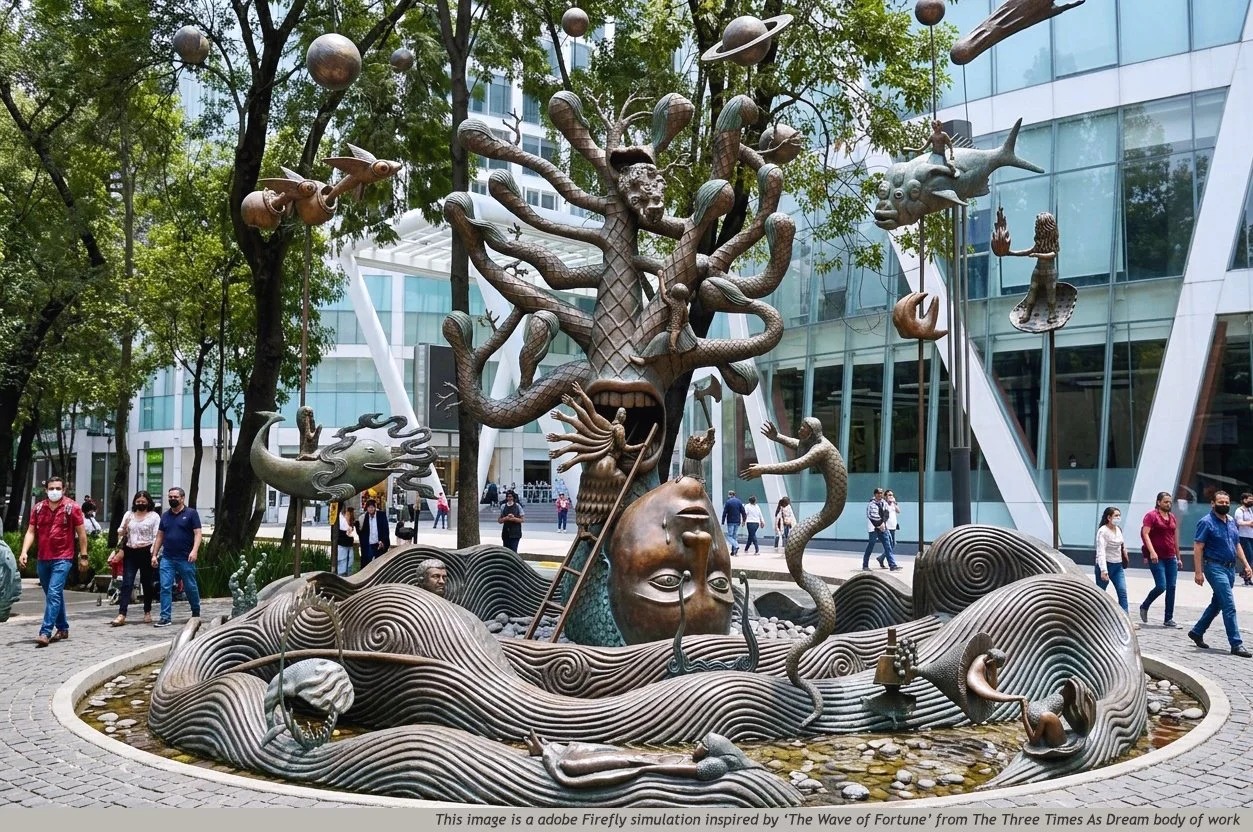
Every human being visits the dreamworld every night. During sleep the brain constructs a completely coherent reality — with gravity, time, memory, other people, narrative and consequence. This world is visited by more people than any gallery or museum in history. No institution has quite held this work before. The Museum of Subconscious is a cross-reality installation in three states. The first is physical: shadow boxes and dream furniture built from reclaimed teakwood, each one a container for a recurring character or landscape from a dream journal kept over many years. These are not representations of dreams — they are objects that hold the interior logic of a specific dream, in the same way a reliquary holds something sacred. The second state is moving image: dream characters emerge from the objects into the surrounding space, projected onto surfaces, walls and floors. The room becomes the dream. The third state is VR/AR: the visitor enters the world the boxes contain. The hypnagogic state — the threshold between waking and sleep — is reproduced spatially. The visitor is inside the dream.
“
“We also live in our dreams, we do not live only by day. Sometimes we accomplish our greatest deeds in dreams.”
”

The Museum of Subconscious is not a fixed exhibition. In each location it is shown, dreams are collected from the local community and added to the archive. The installation that opens in San Francisco holds dreams from Mumbai, the one that opens in Sri Lanka holds the ones from Kerala, home to one of the most sophisticated dream and vision traditions in India. The archive is cumulative, pluralist and permanent — a world collection of the unconscious.
This project is relevant because it tackles profound contemporary dilemmas through a uniquely visceral lens. In a world obsessed with metrics and analytics, reducing every human experience into data, The Museum of Subconscious, asserts the value of the ambiguous, the symbolic, and the un-measurable. The large-scale, shared immersive space can act as a form of social dreaming. By walking through a landscape built from one person's subconscious archetypes, others may find resonance with their own unprocessed material, fostering a sense of shared, unspoken experience. The act of placing dream logic inside furniture and factory is a form of resistance against the draining, mundane efficiency of daily life, suggesting that wonder and significance are hidden in plain sight. The dream space is a crucial territory, a space beyond geography, where identity is not fixed but fluid, layered, and constructed from fragmented memories, languages, and symbols—a powerful statement in a world of hardening borders.
In essence, the museum is a sanctuary for subjective truth, using dream logic to construct a critical, poetic toolkit for examining how we live now. It provides a rare space to physically feel the weight of systemic forces on the human spirit, while simultaneously offering the transformative, liberating possibility of the imagination as a form of dissent and reconnection.
“
Some say that gleams of a remoter world
visit the soul in sleep
”